
Semantic Search#
Sparse retrieval (BM25) relies on exact token overlap between query and document. Semantic search addresses the vocabulary mismatch problem by mapping both queries and documents into a shared dense vector space where proximity reflects meaning rather than surface form.
From sparse to dense retrieval#
Sparse (BM25) |
Dense (bi-encoder) |
|
|---|---|---|
Representation |
Bag-of-words vector |
Fixed-size embedding |
Index size |
Proportional to vocabulary |
Proportional to corpus size |
Latency |
Sub-millisecond |
~1–10 ms with ANN |
Handles synonyms |
No |
Yes |
Training data needed |
No |
Yes (or pre-trained model) |
Explainability |
High |
Low |
In practice the two are complementary: hybrid search (BM25 + dense) often outperforms either alone.
Distributional semantics: topical vs. typical relatedness#
Before picking an embedding model, it helps to understand the two fundamentally different ways words can be “semantically close” — because different model architectures optimise for different kinds of closeness.
Two types of relatedness#
Topical (associative) relatedness — words belong to the same subject matter or semantic field. They co-occur frequently in the same documents, but one cannot necessarily substitute for the other in a sentence.
Examples: doctor & hospital, coffee & mug, sun & beach
Typical (substitutionary / functional) relatedness — words share semantic features and function similarly in a sentence. They can often replace each other without changing grammatical structure.
Examples: car & bus, big & huge, run & walk
How classic embedding models map onto this distinction#
Model |
Mechanism |
Prioritises |
|---|---|---|
Word2Vec (Skip-gram / CBOW) |
Local sliding window (~5 words); predicts nearby context words |
Typical — learns words that appear next to the same context words |
LSA (Latent Semantic Analysis) |
SVD on a global term–document co-occurrence matrix |
Topical — learns words that appear in the same overall documents |
GloVe |
Factorises a global word–word co-occurrence matrix |
Both — strong on analogies (typical) while still capturing topic (topical) |
This distinction has direct practical consequences:
Query expansion built on Word2Vec will surface good synonyms (laptop → notebook) but may miss thematically related terms (laptop → charger).
LSA-style models are better at clustering documents by topic, but poorer at synonym detection.
GloVe is a safer default when you want a single static embedding for general-purpose retrieval.
Contextual models (BERT, Sentence-Transformers) learn both types simultaneously from billions of tokens, which is a key reason they outperform all static embeddings on retrieval benchmarks.
Text embeddings#
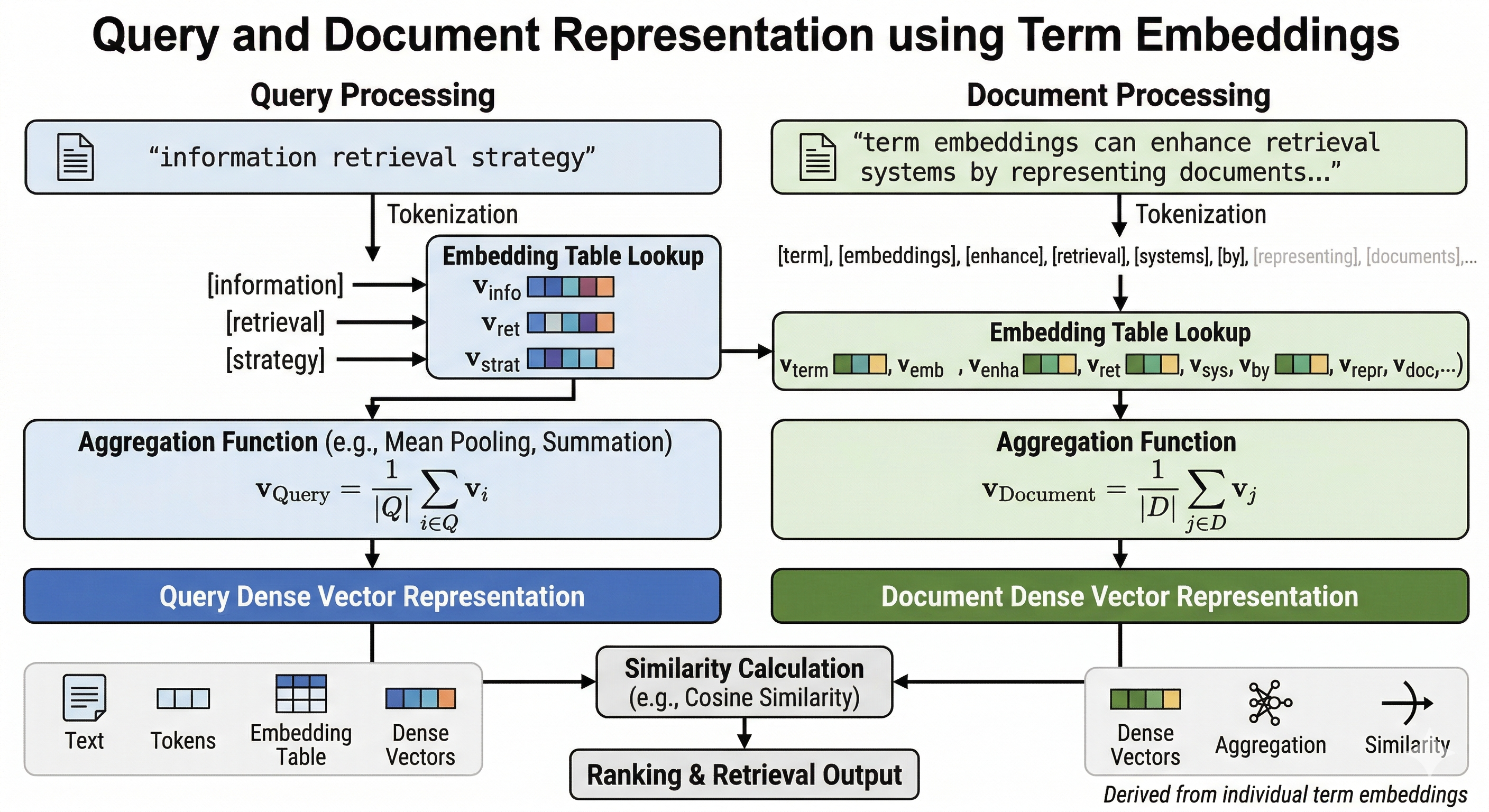
A bi-encoder independently embeds the query and each document with the same encoder (e.g. a fine-tuned BERT / Sentence-Transformers model). Similarity is computed as the dot product or cosine of the two vectors.
Popular pre-trained models:
all-MiniLM-L6-v2— fast, good general-purpose baseline (384 dims)text-embedding-3-small— OpenAI, strong out-of-the-boxe5-large-v2— strong on BEIR benchmarkbge-m3— multilingual, supports sparse + dense hybrid natively
Approximate Nearest Neighbour (ANN) search#
Brute-force cosine search over millions of vectors is too slow. ANN indexes trade a small amount of recall for orders-of-magnitude speed-up:
Algorithm |
Library |
Notes |
|---|---|---|
HNSW |
|
Best recall/speed trade-off; in-memory |
IVF-PQ |
Faiss |
Compressed; scales to billions of vectors |
ScaNN |
Google ScaNN |
Optimised for Google-scale workloads |
DiskANN |
Microsoft |
SSD-based; low memory footprint |
Vector databases#
Managed ANN search + metadata filtering + CRUD:
Pinecone — fully managed, serverless option
Weaviate — open-source, built-in hybrid search
Qdrant — open-source, Rust-based, fast filtering
Milvus / Zilliz — open-source, GPU-accelerated
pgvector — vector extension for PostgreSQL; simplest ops story
Retrieval-Augmented Generation (RAG)#
Semantic search is the retrieval backbone of RAG systems:
query → embed → ANN search → top-k chunks → LLM prompt → answer
Retrieval quality has an outsized impact on answer quality — improving the retriever is usually more effective than prompt engineering.
Evaluation#
Use the same NDCG / MRR / Recall@k metrics as for sparse retrieval. The BEIR benchmark provides a standard heterogeneous test suite across 18 retrieval tasks.